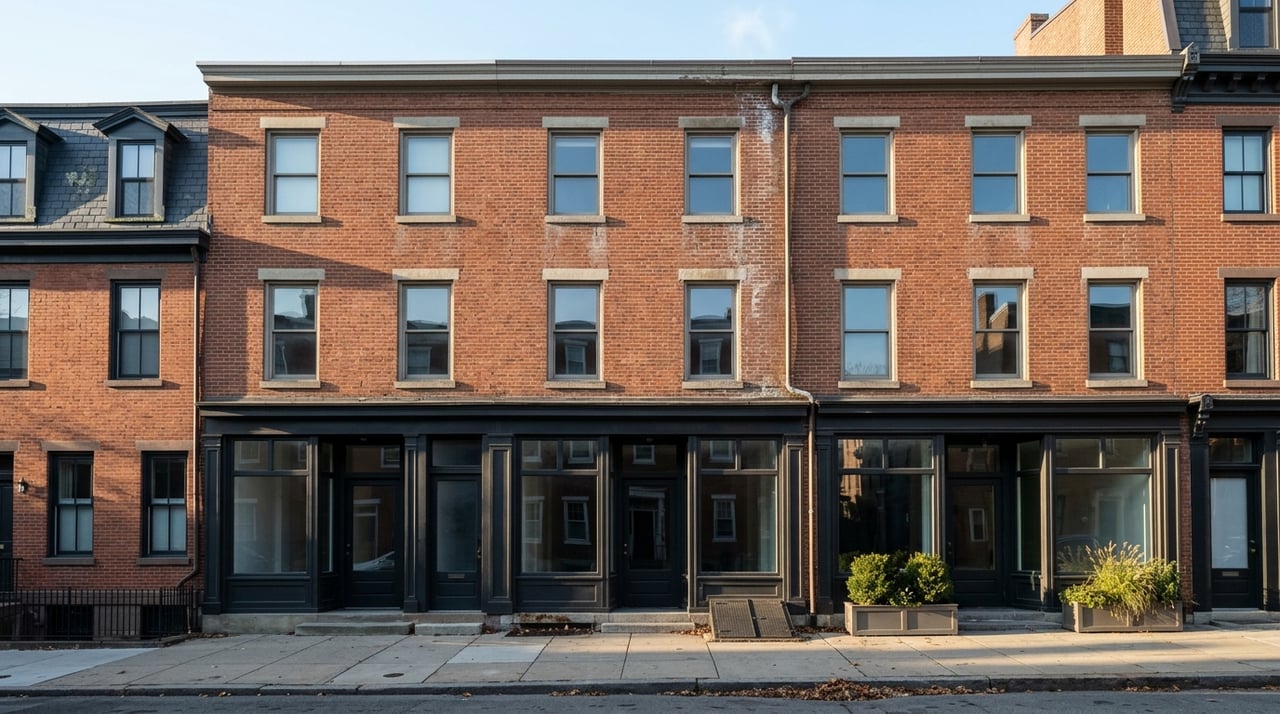
Walk the block between Brattle and Mt. Auburn this month and you'll pass a storefront that used to be split between two different tenants. By early August it belongs to one: About Thyme, a Lebanese fast-casual bakery serving saj-baked wraps and labneh, opened by a first-time restaurant owner named Taha Mikati. A few doors down, the same three-year stretch of sidewalk already hosts Van Leeuwen, Daily Provisions, and Chip City. None of them existed here before 2023.
That density of turnover is the story locals already sense but rarely see laid out. Harvard Square isn't losing its independent character to chains, and it isn't holding steady either. It's sorting its tenants by a different measure: who can cover the rent long enough to matter. A decade-old, multi-location favorite just lost that bet. A guy with no hospitality background and a dozen seats just won it. The Square's turnover this year says more about capital structure than about taste.
Clover Food Lab closed its Massachusetts Avenue location in June after nearly ten years, and the reason wasn't obscure. The company cited a rent increase it called drastic, one it said made the space financially unsustainable for what its spokesperson described as a small local business, even though Clover had grown to a dozen locations across the Boston area before the company shut all of them down in late May. Clover started as a food truck near MIT in 2008, founded by a Harvard Business School graduate. Ten years of foot traffic and brand recognition weren't enough to survive a renegotiation with a landlord who leases the space out to the University.
That closure joined a list the Crimson has been tracking for a while: Allbirds, CorePower Yoga, and the Starbucks at 1 John F. Kennedy Street, which has sat vacant since the chain's location there closed as part of a nationwide pullback. None of these were struggling mom-and-pop operations. They were recognizable, reasonably well-capitalized brands, and they still couldn't make the math work.
Meanwhile, the same stretch of the Square keeps welcoming genuine first attempts. About Thyme is Mikati's first restaurant. He's a Columbia graduate who pitched the idea while interning at a New York coffee chain during undergrad, with zero prior hospitality experience. He landed a corner storefront anyway, in a location the Crimson noted had previously been split between two tenants near three other openings from the past three years.
If you want a single number that captures what's actually filling these spaces, it's this one. BoostBerry Açaí and Smoothies is opening at 99 Mount Auburn Street this August, replacing the former Plan B Salon. When it does, it becomes the fifth açaí concept to open in Harvard Square in six years. Not the second. The fifth.
BoostBerry itself only opened its first location, in Swampscott, in August 2024. It's expanding into the Seaport this summer too. The founders describe it as a family effort to bring authentic Brazilian açaí to New England, and that may be true, but it's also a multi-location expansion pattern, not a corner shop testing an idea. It's opening in the same August wave as Kong Mountain Tea, an online tea brand making its first move into a physical storefront here.
Here's a quick reference for what's actually changed hands this summer, since it's easy to lose track:
| Business | Status | Detail |
|---|---|---|
| About Thyme | Opening early August 2026 | Lebanese bakery, Brattle and Mt. Auburn, first restaurant from a first-time owner |
| BoostBerry Açaí and Smoothies | Opening August 2026 | 99 Mount Auburn St., replacing Plan B Salon, fifth açaí concept in six years |
| Kong Mountain Tea | Opening August 2026 | Online tea brand's first physical Harvard Square location |
| J. August | Reopened February 2026 | 1320 Mass Ave., now under Rally House after ending a run with the COOP that began in 2004 |
| Clover Food Lab | Closed June 2026 | Mass Ave. location shut after a rent increase the company called unsustainable |
| Starbucks, 1 JFK St. | Vacant | Closed as part of a nationwide chain pullback, no new tenant announced |
The businesses moving in aren't uniformly small, and the ones moving out aren't uniformly local. What separates the two groups is whether they arrived with outside backing.
J. August makes the pattern explicit. The store is nearly 140 years old, a fixture across from Harvard Yard since generations before anyone reading this was born. But it closed for two months last December for renovations, and when it reopened in February, it did so under new management: Rally House, a Kansas-based sports merchandise retailer that operates more than 300 collegiate stores across 22 states. The COOP had run the space since purchasing the lease in 2004. Now a national retail company backs the historic name.
Daily Provisions works the same way. It's an all-day cafe from New York's Union Square Hospitality Group, the restaurant company behind Gramercy Tavern and Union Square Cafe. It landed in the Square with national credit behind it before it ever sold a cruller.
Set that against About Thyme. Mikati told the Crimson he wants the drinks and food to be equal partners as the business grows, calling the small drinks program a way to invite people into the cuisine. There's no parent company underwriting that bet. What he had instead was a concept specific enough that a landlord took the risk on an unknown.
The businesses getting squeezed out are the ones in between. Clover had scale, twelve locations and a decade of brand recognition in Boston, but not enough capital behind it to absorb a steep rent reset. That's the actual mechanism here. It isn't independent versus chain. It's whether a tenant has either national backing or a story compelling enough to be worth the landlord's bet on something new. The businesses stuck without either one are the ones packing up.
While storefronts reshuffle by the month, the Square's most visible public space has moved at the opposite speed. The Harvard Square Kiosk, originally built in 1928 as a T station entrance and later home to Out of Town News until 2019, sat vacant through the pandemic and underwent a renovation that took roughly a decade and cost the city $3.3 million. It reopened in May 2025.
City councilors are now questioning whether it's working. According to a city Office of Tourism report, Harvard Square saw nearly 1.24 million visitors in November 2025, and only 1,308 of them stopped at the kiosk. Councilor Patricia Nolan said plainly that the kiosk is not working and is not attracting people, though she also acknowledged that ongoing construction on the surrounding plaza, expected to wrap this fall, may be depressing the numbers. The kiosk is jointly managed by the city's Office of Tourism and Culture House, a Somerville-based arts organization, and some councilors have argued the Harvard Square Business Association would be a more rooted steward. HSBA's executive director, Denise Jillson, has said the organization considered taking on the space but withdrew over restrictions on operating hours and noise, since the group's typical events involve music and crowds the RFP wouldn't accommodate.
The contrast is worth sitting with. Private tenants in the Square turn over in a matter of weeks. The public investment meant to anchor foot traffic in the middle of it all has taken most of a decade to open and still hasn't found its footing.
If you were out in the Square this June and July, you might have noticed something new: people carrying drinks. Cambridge authorized to-go alcohol sales in mapped public consumption zones, including Harvard Square, from June through July 31, part of a state pilot tied to World Cup preparations and the country's 250th anniversary. Approved bars and restaurants could sell drinks for off-premise consumption from 11 a.m. to 11 p.m., and some got permission to stay open until 3 a.m.
Not everyone rushed to use the extended hours. Juan Carlos Herrera, who manages Felipe's Taqueria on Brattle Street, said the business would play it by ear before committing to a 3 a.m. close, citing staff safety protocols that needed to be nailed down first. Rosaline Kovacs, owner of Shay's Pub and Wine Bar, amended her license for the later hours. Either way, the pilot's defined window closed on July 31, so if you got used to strolling past the Kiosk construction with a margarita in hand this summer, that specific arrangement has already run its course.
None of this means Harvard Square is becoming something unrecognizable. It means the Square is proving that survival here isn't about being new or old, chain or independent. It's about whether you've got the backing to absorb a rent reset or a concept sharp enough to be worth the risk without it. Watch what lands on the corners that just turned over this year and you'll see the next round of that sorting play out in real time.
If you're weighing what it actually means to put down roots in a neighborhood that reinvents its storefronts this fast, that's the kind of texture we track for clients every day. Cohen Properties knows Harvard Square block by block, not just by the numbers on a listing sheet. Schedule your free home consultation whenever you're ready to talk through what a neighborhood like this actually means for the way you'll live in it.
Mike embodies a rare combination of scrappy determination and refined confidence. Known for his personable nature and self-deprecating sense of humor, he is able to genuinely connect with people.
Let's ConnectCompass
126 Newbury St 2nd Floor Boston, MA 02116