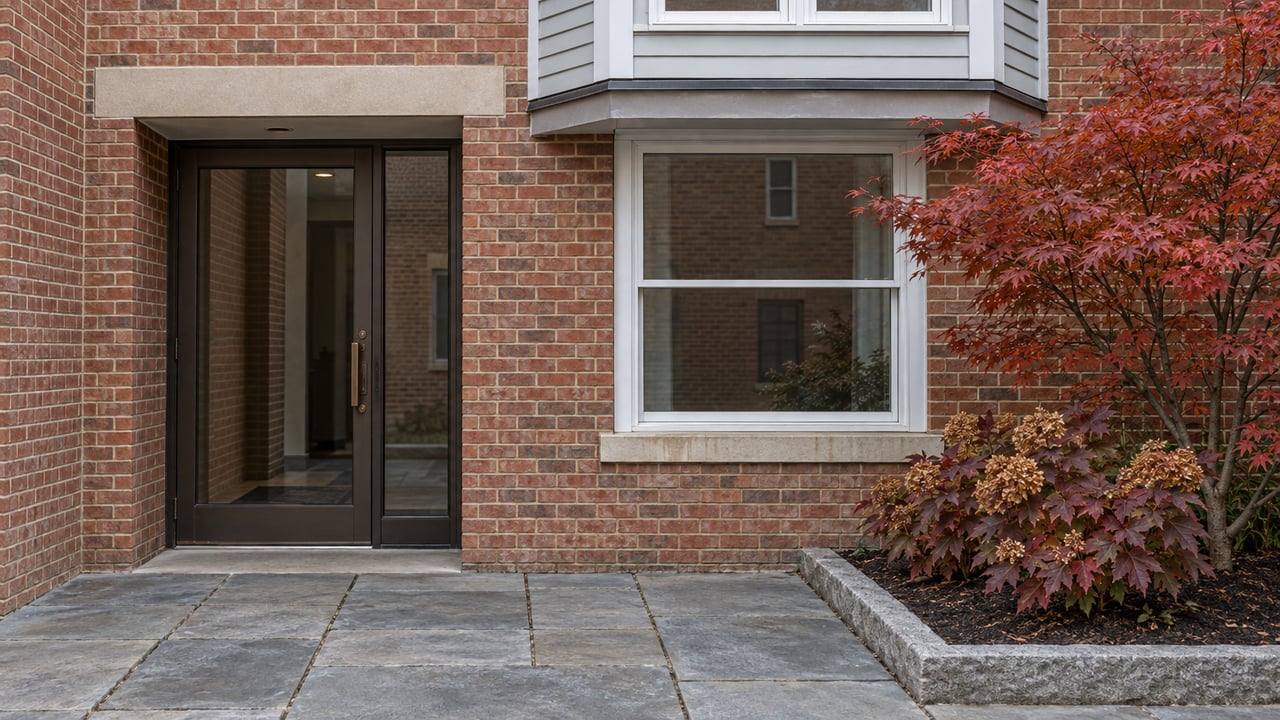
At 11 Ivy Street in Neighborhood Nine, near Fresh Pond, a single-family house came down and eight condominiums are going up in its place. The city's first-quarter 2026 development log lists the project as an as-of-right building under the new Residence C-1 rules. By the log's April 21, 2026 update, it had a building permit. The project needed no special permit and no zoning board hearing, and it stops short of ten units.
The unit count matters most here. Since February 2025, most of Cambridge's residential land allows four stories by right and six on qualifying lots. Most of what is actually going up stays at four stories and under ten units, because of where the city's affordable-housing requirement begins. If you're shopping for new construction in Cambridge, this rule decides what's for sale and where it shows up.
The Multifamily Housing Ordinance took effect February 10, 2025. It folded most of the city's residential areas into a single district, Residence C-1, which allows four stories by right. On lots of at least 5,000 square feet, buildings can go to six stories if they include 20% inclusionary housing.
The inclusionary rule decides the math. As Cambridge Day explained in June 2026, residential buildings with at least ten units or more than 10,000 square feet must set aside 20% of their floor space for affordable units. A building with nine units and less floor area than that can sell every unit at market rate.
The approvals so far follow that line. Cambridge Day reported that the Community Development Department counted 41 multifamily projects approved between February 2025 and late June 2026. At least nine of them have to include affordable units. The other 32 can be entirely market-rate if they stay under 10,000 square feet. Jeff Roberts, the city's Director of Zoning and Development, said the projects breaking ground were "mainly less than 10 units." In July, the Boston Globe described a "particularly notable increase in four-story projects of three to nine units," which it called "a development sweet spot that avoids the affordable housing requirement."
The pattern is easiest to see address by address. This table comes from the city's development log as of April 2026 and from the Globe's July reporting:
| Address | Neighborhood | What was there | What's planned | Status at last report |
|---|---|---|---|---|
| 11 Ivy Street | Neighborhood Nine | Single-family house | 8-unit building | Building permit granted, April 2026 |
| 309 Broadway | The Port | Single-family house, kept | 8-unit new building, 9 homes total | Building permit granted, April 2026 |
| 322 Prospect Street | Wellington-Harrington | Two-family house | 9-unit building | Permit application submitted, April 2026 |
| 54 Hayes Street | Riverside | Three-family house | 9-unit building | Building permit granted, April 2026 |
| 73 Kirkland Street | Mid-Cambridge area | Single-family house | Four-story, four-family building | Under way, July 2026 |
| 214 Allston Street | Cambridgeport | Older two-family house | Two townhouses | Demolition under way, July 2026 |
All four projects in the city log land at eight or nine units, just under the trigger, on lots that held one to three homes. 54 Hayes Street is logged at 9,881 square feet of residential floor area, just below the 10,000-square-foot line. If you're comparing neighborhoods, new construction in Cambridge now mostly means a small condo building on an ordinary residential block, scattered across Neighborhood Nine, The Port, Wellington-Harrington and Riverside. It no longer comes mainly as a large complex on the city's edges. Before the ordinance, the Globe noted, new construction had concentrated in large developments at Alewife and Northpoint.
The table also shows a second version of the sweet spot. At 214 Allston Street, a two-family is being replaced by two townhouses. Councillor Cathie Zusy estimated they would likely be priced well over $2 million each. The Community Development Department told the Globe that projects swapping a small older home for the same number of larger units are "relatively few." Councillor Marc McGovern made the supporters' case at a June hearing. As Cambridge Day reported, he described a developer who might once have built one $3 million single-family home and could now build six townhouses at $2 million each. In both cases, the new homes come in at a high price point.
Larger projects exist, but they move more slowly. The biggest planned project is at 9 Wyman Road in Huron Village, a six-story, 56-unit building on the site of a single-family house. The city log listed it at the pre-permitting stage in April 2026. By July, the Globe reported that demolition had started there, though the project still needed a building permit. The Globe counted roughly ten six-story proposals of 25 to 80 units in planning across the city. Four of them, around Ellery Street and Broadway in Mid-Cambridge, were close to approval.
Cost explains much of the gap. Roberts told councillors that "economic conditions are challenging right now and pretty uncertain for projects of a larger scale." The city's consultant, RKG Associates, found that buildings of six stories or more need steel-frame construction, which costs more to build, as Cambridge Day reported on October 6. On top of that higher cost, the larger building has to give up a fifth of its floor area to affordable units.
The early totals reflect this. According to the Harvard Crimson's coverage of the city's first-year report, Cambridge permitted no new large-scale housing projects in 2025. Fifty smaller developments received permits that year, up from 43 buildings in 2024. The Globe reported about 400 new homes permitted in 2026 through late July, many of them in small and mid-sized multifamily projects. Its review of a tracker kept by Zusy's office found more than 70 sites with at least preliminary plans that together could add over 600 homes. These counts measure different things, approvals, permits and early plans, so they shouldn't be added together. They all point the same way, though.
This fall the city started working on the cost problem. On October 5, 2026, the Community Development Department presented options. They include temporarily lowering the 20% set-aside, letting developers pay into the Affordable Housing Trust in place of up to half the required affordable floor area, tax abatements, and a revolving loan fund. Staff recommended that any changes expire after four to five years unless an extension can be justified. The Council voted 9–0 to send the report to the Ordinance Committee, and nothing was lowered that night. As of Cambridge Day's October 6 report, no committee meeting had been scheduled.
The proposals apply only to projects of six stories or more, mostly outside the C-1 district. In its October 1 coverage, Cambridge Day noted that the city does not recommend reducing the requirement inside C-1, the city's largest district. So even if these options pass, the trigger stays the same for four-story buildings on residential streets. The reason developers keep these buildings under ten units would still be there.
The changes that would affect four-story projects are on a different track, and none have been enacted:
If you're buying an older house, the current rules also tell you what can be built next door. Today, new C-1 buildings can come within five feet of the side and rear lot lines, with a ten-foot minimum setback in front. C-1 projects taller than three stories and 35 feet have to hold a neighbor meeting before they get a building permit. The city publishes these meetings in its residential neighbor notification register. The 2026 entries include 121 and 315 Rindge Avenue. The quarterly development log is useful too, but it leaves out many small projects, so it isn't a complete list.
Do the new eight- and nine-unit buildings include affordable units? Buildings under ten units and under 10,000 square feet don't trigger the 20% requirement. That's why 32 of the 41 projects approved through June 2026 could be entirely market-rate.
Is the six-story allowance being rolled back? Not as of mid-October 2026. Zusy and Councillor Tim Flaherty have proposed limiting six-story buildings to a few major corridors and requiring larger setbacks and off-street parking. The September 28 order only asks staff to draft setback and permeable-space language.
Will lowering the inclusionary rate bring more large buildings? RKG found that a rate change is unlikely to increase investor interest in large projects in West Cambridge. Councillor Ayah Al-Zubi said the biggest problems are interest rates and construction costs, which the city can't control.
If you're deciding between a new nine-unit building in Wellington-Harrington and an older two-family in Cambridgeport, or wondering what the lot next door could turn into, Cohen Properties can go through the permit records and pipeline for the block with you. Schedule your free home consultation.
This article is general information, not legal, tax or financial advice. Consult a qualified professional about your situation.
Mike embodies a rare combination of scrappy determination and refined confidence. Known for his personable nature and self-deprecating sense of humor, he is able to genuinely connect with people.
Let's ConnectCompass
126 Newbury St 2nd Floor Boston, MA 02116